A Macedonian Blessing in Disguise: How Racial EU Exclusion and IMF Contagion Turn a Sovereign Trap into North Macedonia’s Ultimate Shield
PART I: THE REDRAFTED RESEARCH ANALYSIS
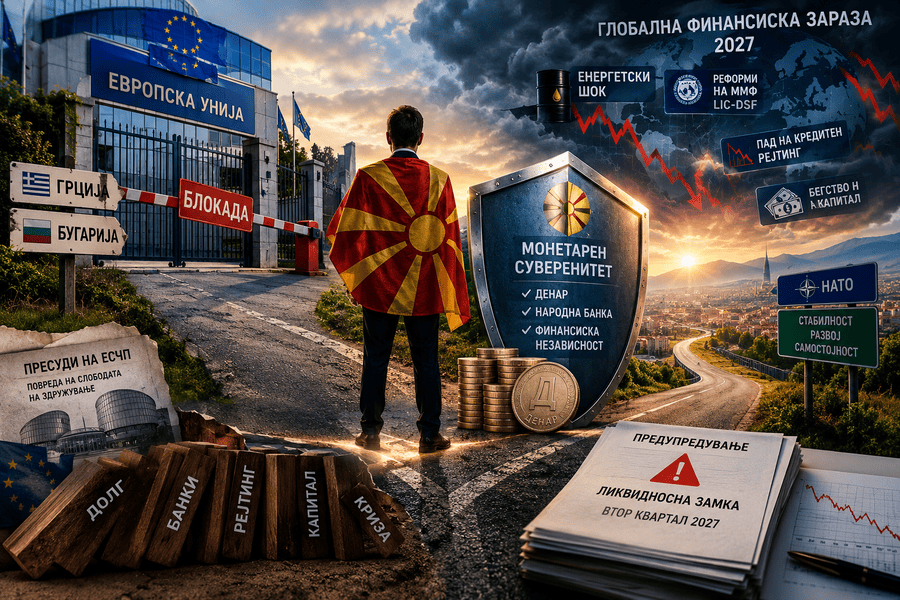
A new academic analysis by Steve Gligorov and Ljupco Bosevski, to be published by PelaNet, warns that North Macedonia faces a “mathematically predictable liquidity trap” in the second quarter of 2027. This crisis is driven by the convergence of three factors: the timing of stricter international debt accounting rules, the timing of a sustained energy shock, and what the authors describe as institutionalized racial discrimination against Ethnic Macedonians within the European Union.
The study applies game theory and macroeconomic legal analysis to expose a profound geopolitical irony: the persistent ethnic discrimination and institutional blockades weaponized by Greece and Bulgaria to keep North Macedonia out of the EU have accidentally handed Skopje its greatest economic shield. By locking North Macedonia out of the European bloc, its hostile neighbors have inadvertently insulated it from an incomplete, hyper-vulnerable monetary architecture. When handed diplomatic lemons, the nation was forced to make world-class macroeconomic lemonade.
Ultimately, the researchers conclude that North Macedonia’s optimal strategy is to happily remain standing on the outside looking in—retaining its monetary sovereignty and NATO security integration while avoiding the EU’s “incomplete monetary architecture.”
The Energy Shock
The analysis begins with the empirical context. Brent crude has sustained levels near $100 per barrel amid escalating Middle East conflicts and shipping bottlenecks in the Strait of Hormuz, according to the United Nations Department of Economic and Social Affairs.[^1] For hydrocarbon-dependent economies, this translates into rapid depletion of foreign currency reserves.
The Overseas Development Institute has documented that prolonged energy disruption and tighter financing conditions are already forcing emergency measures in vulnerable economies.[^2]
North Macedonia is particularly exposed. As of December 31, 2025, gross external debt stood at €12.20 billion (approximately 72% of GDP), while net external debt stood at €4,586 million (approximately 27.1% of GDP), according to the National Bank of the Republic of North Macedonia.[^3]
Foreign exchange reserves reached €4.9 billion as of December 2025, having increased by 44.7% since 2020. However, the researchers note that the reserve accumulation path has not been linear, reflecting “pronounced external shocks and macroeconomic volatility” including the COVID-19 pandemic and the Russia-Ukraine energy crisis.
The sustainability of this reserve position, the authors argue, depends critically on continued external financing—creating a vulnerability to changes in creditor assessments.
The LIC-DSF Domino Effect: From Low-Income Reform to Global Contagion
The investigation’s second pillar focuses on the September 2026 reform to the joint IMF–World Bank Debt Sustainability Framework for Low-Income Countries (LIC-DSF). The World Bank’s Executive Board approved the reforms on September 15, 2026, with the framework expected to become operational in the second half of 2027.[^4]
The reforms introduce four principal changes: a new domestic debt module assessing sovereign-bank linkages; a long-term development module incorporating climate adaptation costs as explicit liabilities; refined thresholds for identifying debt stress; and greater emphasis on comprehensive debt coverage.
[ IMF LIC-DSF Rigid Triggers ]
│
▼
[ Vulnerable Emerging Markets Hit Thresholds ]
│
▼
[ Global Capital Flight & Sovereign Downgrades ] ──► (The Eurozone Achilles’ Heel)
│ │
▼ ▼
[ Exposure to Eurozone “Periphery” Debt ] [ Weak Eurozone Banks Shocked ]
│ │
└───────────────────────┬────────────────────────┘
│
▼
[ EUROZONE LIQUIDITY TSUNAMI ]
A critical piece of structural analysis must be applied here. Traditional critiques point out that the LIC-DSF is technically designed for low-income countries, questioning whether North Macedonia falls directly within its scope. However, this misses the broader systemic threat: global financial contagion.
The LIC-DSF operates “mechanically, not discretionarily.” Once a cluster of vulnerable developing nations cross these rigid new thresholds, it sets off an automated wave of risk warnings, credit downgrades, and panic-driven capital flight. In a highly interconnected global economy, this contraction behaves like an infectious disease. The mechanical downgrades will act as the first falling domino, triggering an immediate liquidity shock across international capital markets.
This is where the Achilles’ heel of the European Union is brutally exposed. Because the Eurozone possesses a unified monetary union but lacks a centralized fiscal transfer mechanism, it acts as a giant conductor for financial shocks. When the contagion from the LIC-DSF hits global liquidity, the shock waves will tear through the fragile financial balance sheets of vulnerable, highly indebted EU member states—including Greece and Bulgaria.
The Math of Default
The core analytical contribution here is a non-cooperative game-theoretic model of interaction between a “Vulnerable Sovereign” (V) and an “International Financial Institution” (IFI).
The model posits that V chooses between “Comply” (accept the revised framework) and “Default/Restructure” (reject compliance and initiate debt restructuring), while the IFI chooses between “Relax” (grant flexibility) and “Enforce” (apply the framework strictly).
The payoff structure incorporates an external energy shock cost (E), compliance cost under the revised framework (C), baseline macroeconomic stability (B), loss of market access due to default (L), and a discrimination cost imposed on the sovereign’s targeted ethnic population (D), among other parameters.
The manuscript derives conditions under which a unique Nash equilibrium emerges. If E > B + L – C—that is, if the energy shock exceeds a threshold determined by baseline stability, market access loss, and compliance costs—the unique equilibrium is (Default/Restructure, Enforce).
The authors acknowledge that the discrimination cost D cancels out when comparing the sovereign’s payoffs under enforcement, but argue that D remains economically significant because it reduces the absolute payoff levels for both strategies. This means the sovereign has less fiscal and human capital to absorb the shock even after restructuring.
A note on the model: The work presents this as a conditional result. It does not establish that E > B + L – C currently holds for North Macedonia, nor does it estimate the values of the parameters. The conclusion that default becomes the dominant strategy depends on assumptions that are not empirically calibrated, but instead take the timing of the events as critical.
North Macedonia’s Position: The Art of Being Left Out
Applying this domino framework to North Macedonia, the paper argues that the country fails the classical Mundell-Fleming criteria for an optimum currency area. The authors cite restrictions on labor mobility, lack of business cycle synchronization with the Eurozone, and—most critically—the absolute absence of a centralized fiscal transfer mechanism in the Eurozone comparable to the United States federal system.
They point to De Grauwe and Ji (2013) for the proposition that this structural lack creates self-fulfilling crisis dynamics in which sovereign stress transmits directly to bank balance sheets, which in turn amplify sovereign stress.[^8] The study also cites recent scholarship from Pfeifer and Schnabl (2026) concluding that “due to persistent heterogeneity, the euro is not an optimal currency area. Cohesion can only be ensured by the ECB and the EU, which entails risks in terms of moral hazard and political legitimacy.”[^9]
Herein lies the structural centerpiece of the authors’ economic comedy. When the 2027 mechanical IMF reforms cause global liquidity to contract, integrated EU members are highly likely to suffer a brutal, amplified rerun of the sovereign debt crises that devastated Greece, Ireland, and Cyprus. The window between the framework’s announcement and implementation is exceptionally short, leaving locked-in Eurozone members virtually no time to adjust their fiscal sails before the tsunami hits.
But because North Macedonia was aggressively kept out of the EU, its domestic banks are not structurally chained to this failing apparatus. By keeping the denar as legal tender, North Macedonia retains three policy emergency levers that its hostile neighbors completely surrendered to Brussels:
Exchange rate flexibility to absorb external shocks.
An independent monetary policy tailored to domestic needs.
A central bank serving as a true lender-of-last-resort.
Ironically, those who built the institutional walls to isolate North Macedonia will find themselves locked inside a burning monetary structure, while the excluded nation watches safely from the lawn, protected by the very sovereignty they were told to abandon.
The Strasbourg Record
The most original contribution of this research is its legal-economic analysis of racial and ethnic discrimination against Ethnic Macedonians, as documented by the European Court of Human Rights (ECtHR).
The foundational case is Ouranio Toxo and Others v. Greece (2005), concerning the political party Ouranio Toxo (Rainbow), founded in 1994, whose declared aims included “the defence of the Macedonian minority living in Greece.”[^5] Factual record metrics established a clear pattern of state-sanctioned hostility:
In September 1995, the party established headquarters in Florina and affixed a sign in Greek and Macedonian. This triggered a wave of violent protests, but national authorities failed to protect them.
Local church and public officials publicly called for their deportation, and the public prosecutor ordered the sign removed, claiming the Macedonian language “was liable to sow discord.”
Crowds led by local mayors openly shouted death threats.
The Court found a unanimous violation of Article 11 (freedom of association), holding that both the acts and omissions of the national authorities violated the ECHR.[^5]
Gligorov and Bosevski argue that this judgment was not an isolated incident. They cite a persistent pattern of systemic blockades across subsequent foundational rulings, including Sidiropoulos and Others v. Greece (1998), House of Macedonian Civilization and Others v. Greece (2015), Stankov & the United Macedonian Organisation Ilinden v. Bulgaria (2001), and The United Macedonian Organisation Ilinden and Ivanov v. Bulgaria (2005).[^6]
The most recent development cited is the 2024 revocation of the registration of the “Centre for the Macedonian Language in Greece” by the Court of Appeal of Western Macedonia. The case was scheduled for hearing on September 21, 2026, before the Greek Court of Cassation, but was officially postponed for a full year.[^7]
The authors argue that this discrimination has direct economic consequences: it depletes social capital, reduces human capital, restricts political voice, and diverts resources from productive activity.
A note on scope: The ECHR findings establish violations of Article 11 (freedom of association). The argument that these violations translate into measurable macroeconomic effects is a theoretical extension by the authors, not a finding of the Court.
The Policy Conclusion
The text concludes that North Macedonia’s optimal strategy is “In NATO, Out of the EU.” NATO membership provides hard security guarantees without macroeconomic conditionality. EU accession, by contrast, forces euro adoption under the Maastricht convergence criteria, requiring North Macedonia to cede its monetary sovereignty without gaining access to real debt mutualization mechanisms.[^10]
The publication recommends immediate defensive measures, including fortifying sovereign liquidity buffers, diversifying external financing sources outside of Western institutions, and strengthening macroprudential banking regulations.
The closing passage states: “The mathematics of the Nash equilibrium and the law of the Strasbourg Court converge on a single conclusion: the optimal strategy for North Macedonia is to retain its monetary sovereignty and hard security alliances while refusing integration into an incomplete and discriminatory institutional architecture.”
PART II: THE STRATEGIC COMMENTARY
Commentary: The 2027 Compressed Timeline vs. The 2010 Eurozone Crisis—Why This Time It’s a Liquidity Tsunami
The global financial architecture is quietly preparing for a massive shift. In September 2026, the IMF and World Bank approved sweeping overhauls to the Debt Sustainability Framework for Low-Income Countries (LIC-DSF).[^4] These updates are scheduled to go fully live in the second half of 2027.[^4]
While market analysts treat this as a routine bureaucratic update, macroeconomic history tells a much darker story. When paired with sustained $100 Brent crude oil,[^1] this rapid implementation window creates an incredibly tight timeline. It mirrors the structural vulnerabilities of the 2010 Eurozone Sovereign Debt Crisis, but with a dangerous twist: the reaction time for vulnerable nations has been completely erased.
⏱️ The Luxury of Time: Looking Back at 2010
To understand how dangerous the 2027 timeline is, we have to look back at how the 2010 Eurozone crisis actually played out. It was a slow-motion car crash that gave policymakers years to build firewalls.
The Multi-Year Warning: The cracks in the Eurozone didn’t appear overnight. Greece’s structural deficits began drawing serious market alarm in late 2009. However, the full-blown sovereign defaults and subsequent bailouts of Ireland, Portugal, and Cyprus didn’t peak until 2011 and 2013.
The Human Mitigation Window: Because the 2010 crisis relied on manual, discretionary credit assessments by traditional rating agencies and political negotiations within the “Troika” (IMF, ECB, European Commission), there was time to negotiate. It took years of emergency summits, backroom deals, and the eventual deployment of the European Stability Mechanism (ESM) to stem the bleeding.
Discretionary Pauses: The market had time to price in the risk. European banks had time to quietly dump toxic peripheral debt, and central banks could step in with discretionary pauses to prevent immediate capital flight.
🤖 The 2027 Tsunami: Algorithm vs. Diplomacy
The upcoming 2027 crisis removes the human element entirely. The new IMF-World Bank framework operates mechanically, not discretionarily. It replaces human deliberation with automated algorithmic triggers.
2010 Crisis: Slow, Discretionary
[Market Alarms] ──► [Months of Negotiations] ──► [Manual Rating Downgrades] ──► [Slow Contagion]
2027 Crisis: Instant, Mechanical
[Rigid LIC-DSF Threshold Crossed] ──► [AUTOMATED MECHANICAL RISK SIGNAL] ──► [INSTANT CAPITAL FLIGHT]
The Zero-Adjustment Window: The IMF explicitly notes that the revised framework introduces “a mechanical risk signal” supported by rigid debt sustainability indicators. This shifts the entire burden of proof. Once an algorithmic model decides a country has crossed a threshold, a downgrade occurs automatically.
The Compressed Execution: In 2010, countries had quarters, if not years, to restructure or implement austerity before being locked out of the markets. In 2027, the operational rollout overlaps directly with peak projected energy shocks.[^1] The moment the automated triggers flip, global capital algorithms will pull liquidity from vulnerable markets in milliseconds.
The Incomplete Eurozone Traps Its Inhabitants: Because the Eurozone still has not fixed its foundational flaw—a shared currency without a centralized fiscal transfer mechanism—it remains a highly efficient conductor of financial contagion. When the automated LIC-DSF rules trigger a wave of emerging-market defaults, the liquidity shock will travel instantly into the balance sheets of vulnerable EU member states like Greece and Bulgaria.
🍋 The Ultimate Irony: An Accidental Sanctuary
This compressed timeline highlights the brilliant irony outlined by Steve Gligorov and Ljupco Bosevski.
In 2010, being outside the Eurozone or the EU was seen as an economic disadvantage. In 2027, it is the ultimate sanctuary. Because Greece and Bulgaria successfully used institutional blockades to block North Macedonia’s entry into the EU, they accidentally saved Skopje from the mechanical trap they are about to fall into.
When the automated liquidity tsunami hits in late 2027, Eurozone members will have no time to adjust, no monetary policy levers to pull, and no independent currency to devalue. They will be locked inside an incomplete monetary structure with an algorithm that doesn’t care about political diplomacy. Meanwhile, North Macedonia will watch from the outside, holding its independent currency, its independent monetary policy, and an accidental shield forged by the very neighbors who tried to isolate it.
DOCUMENT FOOTNOTES / SOURCES CITED
[^1]: United Nations Department of Economic and Social Affairs (DESA), “Global Growth Under Pressure as Energy Shock Renews Inflation Risks and Heightens Uncertainty,” UN News, 2026.
[^2]: Overseas Development Institute (ODI), “Resilience Under Pressure: Prolonged Energy Disruption and Tighter Financing,” ODI Insights, 2026.
[^3]: National Bank of the Republic of North Macedonia, “Significant Changes in the External Debt, External Claims and International Investment Position: Fourth Quarter of 2025,” March 26, 2026.
[^4]: World Bank, “World Bank Board Endorses Reforms to the Bank-Fund Debt Sustainability Framework for Low-Income Countries,” September 21, 2026.
[^5]: Ouranio Toxo and Others v. Greece, no. 74989/01, ECtHR (First Section), judgment of 20 October 2005.
[^6]: Consolidated European Court of Human Rights Cases: Sidiropoulos and Others v. Greece, no. 26695/95, judgment of 10 July 1998; House of Macedonian Civilization and Others v. Greece, no. 1295/10, judgment of 9 July 2015; Stankov and the United Macedonian Organisation Ilinden v. Bulgaria, nos. 29221/95 and 29225/95, judgment of 2 October 2001; The United Macedonian Organisation Ilinden and Ivanov v. Bulgaria, no. 44079/98, judgment of 20 October 2005.
[^7]: ABTTF (Federation of Western Thrace Turks in Europe), “The Court of Cassation in Greece has postponed the case concerning the Centre for Macedonian Language for a year,” September 23, 2026.
[^8]: De Grauwe, P., & Ji, Y., “Self-Fulfilling Crises in the Eurozone: An Empirical Test,” Journal of International Money and Finance, 34 (2013): 15–36.
[^9]: Pfeifer, M., & Schnabl, G., “The Euro as an Optimum Currency Area? A Reappraisal,” Flossbach von Storch Research Institute, August 27, 2026.
[^10]: Gligorov, S., “A Ticking Economic Time Bomb: Exposing the EU’s Secret Design to Destroy North Macedonia,” PelaNet, August 31, 2026.
COMPREHENSIVE POLICY RESEARCH DOSSIER
Document Classification:
Strategic Economic Analysis & Commentary
Subject: Sovereign Debt Contagion, Eurozone Flaws, and External Shocks (2026–2027)
Core Source Material: Gligorov, S., & Bosevski, L. (2026).
A Ticking Economic Time Bomb Running Out of Time: Institutional Debt Reform, Energy Shocks, and the Racial Discrimination of Ethnic Macedonians in the European Union (2026–2027). PelaNet
Пишува од Вашингтон, Д.Ц., САД, STEVE GLIGOROV, J.D., Esq., B.S., Cert. in Int’l Trade Law & Int’l Comm. Arb., Original Co-Founder of the United Macedonian Diaspora
Ставовите се лични ставови на авторите и Pelanet.mk не носи одговорност за нив.