THE CULMINATING POINT OF ENLARGEMENT
Clausewitz, Sun Tzu, and the Strategic Attrition of the “8 SEPTEMBER 1991” Macedonian Pro-European Consensus
Abstract
This article examines the Republic of North Macedonia’s post-1991 independence and its subsequent European Union accession impasse through Clausewitzian and Sun Tzu strategic frameworks. It argues that the veto-driven accession process functions as bureaucratic warfare: a continuation of political contest by procedural means in which identity-related bilateral disputes are uploaded into EU unanimity rules and converted into instruments of coercion. The article develops two theoretical moves. First, it inverts Clausewitz’s culminating point to locate it in the defending polity—Macedonian pro-European public opinion—rather than in the advancing EU conditionality. Second, it integrates the Clausewitzian trinity, Sun Tzu’s indirect approach, the DIME taxonomy, and negotiation-theoretic BATNA into a single framework for analysing enlargement conditionality. Empirically, the article maps the dispute across diplomatic, informational, military-latent, and economic lines; assesses the strategic posture of the VMRO-DPMNE government elected in 2024; and argues that the recurrent identity-based vetoes warrant scrutiny under the International Convention on the Elimination of All Forms of Racial Discrimination. The article concludes that Skopje must strengthen its BATNA through non-EU economic diversification, NATO leverage, and diaspora advocacy before pro-European sentiment passes its culminating point.
Keywords: EU enlargement, North Macedonia, Clausewitz, Sun Tzu, BATNA, racial discrimination, ICERD, DIME, Prespa Agreement, Bulgarian veto.
1. INTRODUCTION
On 8 September 1991, the electorate of what was then the Socialist Republic of Macedonia voted overwhelmingly in a referendum to become a sovereign and independent state. The newly christened Republic of Macedonia emerged from the dissolution of Yugoslavia as a rare case of peaceful secession, and its founding political consensus oriented the country decisively toward Euro-Atlantic integration. President Kiro Gligorov, who would remain in office until 1999, articulated a foreign policy predicated on the assumption that democratic consolidation and market liberalisation would be rewarded with membership in the European Union and, eventually, the North Atlantic Treaty Organisation.
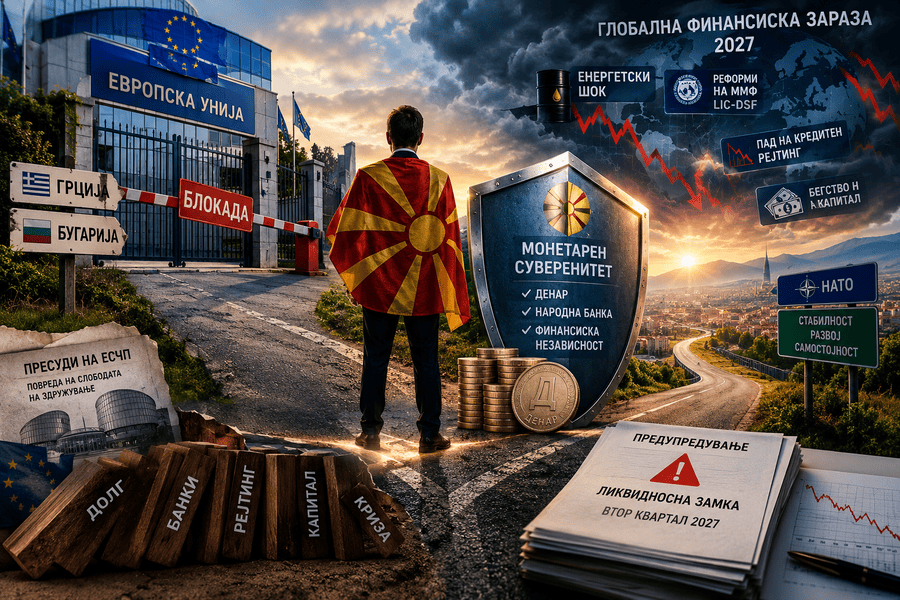
Three and a half decades later, that foundational assumption remains unfulfilled. The Republic of North Macedonia—as it has been constitutionally designated since the entry into force of the Prespa Agreement in 2019—has held EU candidate status since 2005, yet has opened no substantive accession chapters under the current negotiating framework.[1] The country joined NATO in March 2020, but its European trajectory has been obstructed by a sequence of bilateral vetoes: first by Greece over the name dispute, then by Bulgaria over questions of language, historiography, and minority recognition.[2] These vetoes are not technical. They concern the recognition and equality of ethnic Macedonian identity. The cumulative effect has been what this article conceptualises as bureaucratic warfare—a prolonged strategic attrition conducted through the procedural instruments of EU conditionality rather than through military force.[3]
This article advances three interrelated arguments. First, it contends that the EU accession process, in the Macedonian case, functions as a Clausewitzian continuation of politics by other means, in which veto-wielding member states deploy bilateral identity-related grievances as leverage within a unanimity-based institutional framework. Second, it argues that the incumbent VMRO-DPMNE government, elected in 2024 on a platform of rhetorical defiance toward EU conditionality, has been operationally weak despite discursive strength—producing a strategic posture rich in symbolism but deficient in leverage. Third, and most consequentially, the article proposes that pro-European public opinion in North Macedonia has passed what Clausewitz termed the culminating point: the moment at which an offensive exhausts its momentum and begins to decay. This theoretical move inverts the conventional Clausewitzian application, locating the culminating point not in the attacking force, but in the defending polity.
A fourth, transversal argument is that the pattern of identity-based vetoes warrants scrutiny under the 1965 International Convention on the Elimination of All Forms of Racial Discrimination (ICERD), because the disputed grounds—language, historiography, ethnonym, and national or ethnic origin—fall within the Convention’s definition of racial discrimination.[4]
The theoretical framework integrates three intellectual traditions rarely brought into conversation in European integration literature. Carl von Clausewitz’s Vom Kriege provides the conceptual vocabulary of political coercion, friction, the trinity, and the culminating point.[5] Sun Tzu’s Art of War supplies the logic of indirect approach, of winning without fighting, and of exploiting positional advantage.[6] The DIME taxonomy—Diplomatic, Informational, Military, Economic—functions as an organising heuristic for mapping the multi-domain character of the accession dispute. Negotiation theory, and particularly the concept of BATNA, anchors the analysis of leverage asymmetries.[7]
The empirical focus is North Macedonia’s post-2018 trajectory, with particular attention to the period following the Bulgarian veto of December 2020 and the election of the VMRO-DPMNE government in 2024. The article draws on official EU documents, bilateral treaties, parliamentary records, and public opinion data, supplemented by process-tracing of critical junctures including the Prespa Agreement, the 2019 French non-paper on enlargement reform, and the 2022 negotiating framework.
The structure of the article is as follows. Section 2 reviews the literature on EU enlargement, strategic theory, and negotiation, identifying the gap this article addresses. Section 3 operationalises the theoretical framework, specifying how Clausewitzian and Sun Tzuian concepts are mapped onto the DIME domains. Section 4 analyses the accession dispute across each of the four DIME lines. Section 5 develops the argument about the culminating point of public opinion. Section 6 assesses the strategic posture of the VMRO-DPMNE government. Section 7 synthesises the analysis through Clausewitz’s trinity and the ICERD framework. Section 8 concludes with theoretical and policy implications.
2. LITERATURE REVIEW AND THEORETICAL FRAMEWORK
This article sits at the intersection of three scholarly conversations that have proceeded largely in parallel: the literature on European Union enlargement and conditionality, the revival of classical strategic theory in international relations, and the negotiation-theoretic literature on bargaining leverage. This section reviews each, identifies the points of productive friction, and specifies the gap this article addresses.
2.1 EU Enlargement Studies: From Transformative Power to Conditionality Crisis
The scholarly literature on EU enlargement underwent a productive period of consensus-building in the decade following the 2004 and 2007 enlargements. The dominant theoretical framework—often characterised as rationalist institutionalism—was established by Schimmelfennig and Sedelmeier, who argued that EU conditionality functions as an external incentive structure: candidate countries comply with the acquis communautaire when the expected benefits of membership outweigh the domestic costs of reform.[8] This model, sometimes termed the “external incentives model,” treated the EU as a rational actor offering a credible membership perspective in exchange for policy convergence.
Complementing this rationalist account, a second body of work emphasised the EU’s role as a transformative or normative power. Vachudova distinguished between “active” and “passive” leverage, arguing that the EU’s most profound effects on candidate states operated through the diffusion of norms and the restructuring of domestic political fields, often independent of formal conditionality.[9] Börzel and Risse developed the concept of Europeanisation as a multi-directional process, in which EU norms are downloaded by candidates but also reinterpreted and occasionally resisted in domestic contexts.[10]
The post-2007 enlargement round—encompassing the Western Balkans—has exposed significant limitations in both models. Dimitrova and Vachudova have documented the erosion of conditionality’s credibility, attributing it to “enlargement fatigue” among member states, the absence of a credible membership timeline, and the intrusion of bilateral disputes into the unanimity-based ratification process.[11] Bieber has characterised the post-2013 enlargement process as “stabilisation without Europeanisation,” in which elites in candidate countries perform technical compliance while resisting substantive democratic reform.[12] The French non-paper of November 2019, which effectively blocked the opening of accession talks with North Macedonia and Albania, and the subsequent reformed methodology of February 2020, formalised a more politically intrusive, phased approach that granted individual member states additional veto points.[13]
The Bulgarian veto of December 2020—invoking questions of historical narrative, minority recognition, and language—further complicated the enlargement framework by introducing identity-based conditionality alongside the traditional technical criteria. Nechev and Ristović have argued that this shift represents a qualitative transformation of the accession process, in which the resolution of bilateral historical disputes has become a de facto precondition for progress, a requirement that sits uneasily with the formally merit-based Copenhagen criteria.[14]
2.2 Classical Strategic Theory in International Relations
The literature on EU enlargement has been notably reticent to engage with classical strategic theory. This is a surprising omission, given that the accession process involves precisely the kind of prolonged political contestation that theorists of strategy have analysed for centuries. Two classical texts provide the foundational vocabulary for this article: Carl von Clausewitz’s Vom Kriege and Sun Tzu’s Art of War.
Clausewitz’s enduring contribution is the proposition that war is a continuation of policy by other means—a formulation that dissolves the conventional boundary between military and political action and invites analysis of any coercive interaction through a strategic lens. Three further concepts are central to this article’s analytical framework. Friction—the aggregate of minor resistances, accidents, and uncertainties that make “the simple difficult and the difficult impossible”—provides a useful vocabulary for the procedural obstructions of EU conditionality. The culminating point of victory, which Clausewitz describes as the moment at which an offensive exhausts its capacity and risks reversal, is invoked in an inverted sense to analyse the trajectory of pro-European sentiment in candidate states. Finally, the trinity—the interplay of passion, chance, and reason—offers a framework for understanding the multi-level dynamics of the accession dispute.[15]
Sun Tzu’s corpus, though far less systematic than Clausewitz’s, has proved influential in contemporary strategic thought, particularly through its emphasis on indirect approach and positional advantage. The axiom that “the supreme art of war is to subdue the enemy without fighting” is relevant to the diplomatic dimension of the accession dispute, where blocking states seek to extract concessions without resorting to explicit sanctions or military coercion.[16] Sun Tzu’s insistence on knowing both oneself and one’s adversary, and his emphasis on the importance of terrain and timing, supply an analytical vocabulary for the strategic choices facing candidate states.
The application of classical strategic theory to non-military domains has been developed by scholars such as Handel, who analysed the position of weak states within the international system, and Gray, who argued for the essential unity of strategic logic across military and non-military contexts.[17] Within the European integration literature, however, strategic theory remains marginal—cited, when at all, in the context of security and defence policy rather than enlargement conditionality. This article addresses that gap by operationalising Clausewitzian and Sun Tzuian concepts as analytical tools for understanding the accession dispute.
2.3 Negotiation Theory and BATNA
A third relevant body of literature derives from negotiation theory, particularly the Harvard Negotiation Project’s concept of BATNA. BATNA—Best Alternative to a Negotiated Agreement—designates the most advantageous course of action available to a party should negotiations fail; its strength determines a negotiator’s reservation value and, consequently, its leverage. A party with a weak BATNA is, in principle, more dependent on reaching agreement and therefore more vulnerable to the demands of its counterpart.[18]
Subsequent scholarship has refined and extended the BATNA framework. Raiffa, Richardson, and Metcalfe emphasised the importance of actively improving one’s BATNA as a strategic choice, while Mnookin explored the challenges of negotiating with adversaries whose good faith is in doubt.[19] These contributions are particularly relevant to the Macedonian case, in which the EU candidate status effectively locks the candidate into a single negotiation track with limited alternative options.
2.4 The Research Gap
The three bodies of literature reviewed above have proceeded largely in parallel. Scholars of EU enlargement have focused on the institutional and normative dimensions of the accession process. Strategic theorists have analysed military and security competition but have rarely turned their conceptual apparatus toward European integration. Negotiation theorists have studied BATNA and leverage in a wide range of contexts but have not systematically engaged with classical strategic thought.
This article addresses the resulting gap by integrating these three traditions into a unified analytical framework. It operationalises Clausewitzian and Sun Tzuian concepts to analyse the EU accession dispute across the DIME domains, deploys BATNA theory to assess the leverage dynamics, and proposes the concept of a culminating point of public opinion as a theoretical contribution to the literature on enlargement fatigue.
3. ANALYTICAL FRAMEWORK: OPERATIONALISING CLAUSEWITZ, SUN TZU, AND DIME
Clausewitz defines war as “an act of force to compel our enemy to do our will” and, famously, as “a mere continuation of policy by other means.” In the post-1945 European order, coercion is exercised mostly short of armed force; its instruments are diplomatic, informational, military-latent, and economic—the DIME taxonomy of national power. What follows reads the accession dispute as a political conflict in the strict Clausewitzian sense: a contest of opposed wills, each seeking to impose its terms on the other. Nothing in this framing requires conspiracy; Clausewitz’s enduring value is precisely that he explains how ordinary politics hardens into struggle.[20]
Sun Tzu supplies the indirect logic: “to subdue the enemy without fighting is the acme of skill.” In the Macedonian case, neighbouring EU member states deploy historical narratives and diplomatic vetoes as indirect weapons to stall Skopje’s EU integration. The DIME heuristic is not a claim that all four domains are equally active; it is an organisational device for detecting pressure points and centres of gravity.
Table 1. Strategic concepts and Macedonian applications
| Concept | Origin | Analytical meaning | Macedonian application |
|---|---|---|---|
| Political object | Clausewitz | What each side wants | Greece: name settlement; Bulgaria: language/historiography; EU: stability; Skopje: membership |
| Friction | Clausewitz | Procedural resistances | Vetoes, benchmarks, intergovernmental conference delays |
| Culminating point | Clausewitz | Offensive exhausts momentum | Erosion of pro-European public opinion |
| Trinity | Clausewitz | Passion, chance, reason | Domestic identity politics; enlargement fatigue; governmental calculus |
| Schwerpunkt | Clausewitz | Centre of gravity | EU economic mass; Skopje’s EU dependence |
| Indirect approach | Sun Tzu | Win without fighting | Vetoes as non-military coercion |
| BATNA | Fisher and Ury | Best alternative to negotiated agreement | Non-EU FDI, NATO leverage, diaspora advocacy |
Two further points are necessary before the empirical analysis. First, the Clausewitzian culminating point is operationalised in inverted form: the offensive is the EU’s conditionality framework, while the attrition is borne by pro-European Macedonian public opinion. Second, leverage is assessed through BATNA. A weak BATNA makes a negotiator dependent on agreement; a strong BATNA enables it to say no. In game-theoretic terms, strengthening alternatives shifts the bargaining equilibrium toward a more favourable Nash solution.[21]
4. DIME ANALYSIS OF THE MACEDONIAN ACCESSION DISPUTE
4.1 D — Diplomacy: The Bilateral Made Multilateral
For Clausewitz, the first question in any conflict is the political object: what does each side actually want? Greece’s object was settlement of the name question—largely achieved in the Prespa Agreement of 2018—yet identity-based conditionality persisted. Bulgaria’s object concerns Macedonian language and Macedonian cultural historiography, codified in the 2017 Friendship Treaty and enforced through the 2020 veto and the 2022 negotiating framework.[22]
The diplomatic lesson is bleakly Clausewitzian: limited political objects do not automatically produce limited conflicts, because each bilateral dispute, once uploaded into the EU’s unanimity rule, acquires multilateral veto power.
Friction—Clausewitz’s term for the thousand small resistances that make the simple difficult—is institutionalised: every chapter, benchmark, and intergovernmental conference becomes a checkpoint at which a single capital can apply the brake. For Skopje, therefore, the diplomatic line cannot be mere compliance. Compliance that produces no movement transforms the political object in the eyes of the domestic audience: the object becomes the process itself, not membership. A government that keeps supplying concessions after the Prespa precedent without securing returns is, in Clausewitzian terms, allowing the opponent to dictate the rhythm of the campaign.
4.2 I — Information: The Moral Domain
Clausewitz ranks moral forces—legitimacy, morale, narrative—among the most important elements of war, and Sun Tzu goes further: “to subdue the enemy without fighting is the acme of skill.” The Macedonian identity dispute is fought primarily here: over names, ethnonyms, constitutional inscriptions, and textbooks.
Le Queux’s 1907 dispatch, The Near East: The Present Situation in Montenegro, Bosnia, Servia, Bulgaria, Roumania, Turkey and Macedonia, should be read in this light—as an information-domain artefact. It is factual evidence that the questions of genocide, racial discrimination, and ethnic cleansing of ethnic Macedonian identity have been a covert European narrative battlefield for over a century.[23]
Two informational asymmetries matter. First, the EU controls the racially discriminatory conflict-of-interest master narrative of merit-based enlargement, which converts every discriminatory delay into the candidate’s deficiency. Second, EU enlargement fatigue supplies a ready-made fog of war: public opinion in member states is indifferent, and indifference is a resource a blocking capital can spend cheaply. The counter-strategy is Sun Tzu’s—do not attack the strength, the EU’s self-image as a rules community, but the strategy: reframe the dispute from “candidate fails criteria” to “the EU unanimity rule allows bilateral racialised EU grievances to hijack multilateral promises.” That reframing is the informational centre of gravity.
This is not a new observation. In 2004, Steve Gligorov and Meto Koloski, two of the original co-founders of the United Macedonian Diaspora, published “Decentralization, or Euro-Discrimination?” in International Affairs Forum, noting that the name negotiations imposed on Macedonia by EU member states had de facto deprived millions of Macedonians worldwide of the basic right of self-identification. The UMD delegation argued that the name negotiations between Macedonia and Greece were “merely used as a smoke screen to veil state-sponsored human rights violations against ethnic Macedonians” living in Greece. Twenty years later, the racialised vetoes of EU member states are once again functioning as a smoke screen for the same structure.[24]
4.3 M — Military: The Latent Instrument
There is no shooting war, and that is precisely the point. The military element operates as architecture and alignment. NATO membership in 2020 gave Skopje strategic depth—in Clausewitzian language, it reinforced the defensive, “the stronger form of war.” But alignment conditionality also converts the military line into a pressure gauge: sanctions alignment, procurement patterns, and mission contributions are monitored as loyalty metrics.[25]
The lesson for Macedonian strategy is that, for a small state, the military line is not a weapon but a shield that buys time for the other three lines to work. Military integration reduces the probability of conventional coercion, but it does not by itself dissolve the anti-Macedonian, racially discriminatory political vetoes against ethnic Macedonian identity, culture, history, language, and religion that consistently thread through EU institutions.
4.4 E — Economics: The Gravity Model as Strategy
The gravity model of foreign direct investment and trade is the sharpest Clausewitzian insight in the Macedonian case, intended or not: trade and investment flow along economic mass and distance, and the EU’s economic mass makes dependence structural. Dependence is a centre of gravity in the strict sense—the source of the opponent’s leverage. Clausewitz teaches the identification of the adversary’s Schwerpunkt and the protection of one’s own; here, Skopje’s own EU economic concentration is the vulnerability.[26]
Diversification of bilateral non-EU global investors—the demand placed on VMRO—is therefore not economic trivia, but strategic manoeuvre: Sun Tzu’s “avoid the strong, strike the weak,” translated into capital flows. Every global non-EU investor of size marginally reduces the cost of a veto in Brussels because it marginally raises the cost of losing Skopje’s goodwill.
This is where BATNA becomes decisive. If Skopje’s only option is “the EU at any cost,” its BATNA is weak—the veto players know there is no plan B and keep raising the price. By building economic alternatives, NATO leverage, and bridging Macedonian diaspora civil and human rights advocacy influence, Skopje can strengthen its BATNA and force the EU to negotiate rather than dictate. In game-theoretic terms, this shifts the equilibrium toward a new Nash solution, proving that Macedonian ethnic identity is a non-negotiable geopolitical asset, not a zero-sum accession concession.[27]
5. THE CULMINATING POINT OF PRO-EUROPEAN PUBLIC OPINION
The culminating point—the moment an offensive exhausts itself—applies not to Brussels but to Macedonian public opinion. Pro-European sentiment, once overwhelming, has eroded with each moved EU anti-Macedonian racial discrimination goalpost. The Prespa Agreement was presented as a historic compromise that would unlock accession. Instead, it was another lie that was followed by the French non-paper, the Bulgarian veto, and a revised negotiating framework that introduced additional anti-Macedonian racial discrimination conditions. Each EU head-fake cycle raised Macedonian expectations and then deferred delivery and exposed EU lie upon EU lie.
The strategic danger is not conspiracy; it is something more banal and more Clausewitzian: that the blocking strategy “succeeds” precisely when the will to join has passed its culminating point, leaving the EU a candidate that no longer wants the prize. Survey evidence from successive Eurobarometer and International Republican Institute polls shows a long-term decline in trust in EU conditionality and increasing disengagement from the accession process.[28]
This is the central paradox of the Macedonian case. The EU’s formal enlargement architecture assumes a candidate whose domestic population is willing to bear transition, namely: the complete concealing of EU member states’ historical genocide of Macedonians in Macedonia, racial discrimination against Macedonian ethnic identity, race, language, culture, history, and church, in exchange for eventual fantasy fake EU membership. But when conditionality becomes a permanent feature rather than a transitional mechanism, the pro-European constituency is asked to pay indefinitely without a credible terminus. At some point, rational publics discount the promised reward. That point is the culminating point of enlargement. No more EU fake news against Macedonians!
6. THE STRATEGIC POSTURE OF THE VMRO-DPMNE GOVERNMENT
The current VMRO-DPMNE government correctly identifies the racialised identity dispute with EU member states as the central front, but it fights it reactively, responding to Athens, Sofia, and Brussels rather than setting the agenda. Rhetorically defiant on identity, tangible results are absent. The Bulgarian veto remains unbroken. No new bilateral leverage has been secured. Constitutional-amendment resistance has stalled the French framework without producing an alternative pathway. Diplomatic diversification—non-EU global investors, synchronised diaspora human rights mobilisation—remains aspirational, not operational.
If one applies a simple scorecard—diplomatic breakthrough, institutional leverage, economic global diversification, information dominance—the government currently rates in the C−/D+ range. It has been strong with words but less strong in action. A strategist without a plan is merely a protester with a flag. VMRO must convert rhetoric into measurable diplomatic and economic outcomes; it must stop passing up billions offered by Asian global investors who are not from the racial discrimination conflict-of-interest EU, but tend to be racial discrimination-neutral against Macedonians and much more business-only-oriented, pointing from all Asia, the Americas at large, and the Middle East, all of which are, by and large, not anti-Macedonian, in stark contrast to the EU and its EU member states.
The operational imperative is to improve Macedonia’s BATNA. Instead of accepting EU vetoes as if they are “EU Racial Discrimination As A Service,” Skopje and especially this VMRO government must diversify foreign direct investment toward high-growth non-EU markets—such as Asia and Latin America—to reduce EU dependency and to stop restraining Macedonia with the race-based conflict-of-interest conditionality embedded in the EU-imposed acquis communautaire. Macedonia must leverage NATO membership asymmetrically by providing regional security value, forcing Brussels to negotiate rather than dictate. It must synchronise targeted Macedonian diaspora civil rights advocacy in Washington to bypass EU racialised anti-Macedonian ethnic identity frictions. By making non-EU integration viable and NATO cooperation indispensable, VMRO can force a new equilibrium, proving that Macedonian ethnic identity is a non-negotiable geopolitical asset, not a zero-sum accession concession.[29]
Time is short. VMRO is short on time, and this must immediately become focused on actions, not merely words.
7. SYNTHESIS: THE TRINITY AND THE ICERD FRAMEWORK
Finally, the trinity: passion—domestic identity politics in Athens, Sofia, and Skopje; chance—enlargement fatigue, crises that crowd out the Balkans; and reason—the cold calculus of each government. The dispute persists because all three nodes feed it; no single DIME line addresses all three.
The identity-based vetoes also engage a legal register. Article 1(1) of the 1965 International Convention on the Elimination of All Forms of Racial Discrimination defines racial discrimination as:
any distinction, exclusion, restriction or preference based on race, colour, descent, or national or ethnic origin which has the purpose or effect of nullifying or impairing the recognition, enjoyment or exercise, on an equal footing, of human rights and fundamental freedoms in the political, economic, social, cultural or any other field of public life.[30]
The disputed grounds in the Macedonian case—language, historiography, ethnonym, and the recognition of ethnic Macedonian identity—fall squarely within the categories of national or ethnic origin. When accession vetoes condition progress on the acceptance of a particular national narrative, they create a distinction based on national or ethnic origin that has the effect of impairing equal treatment and the right to self-identification. The Le Queux 1907 text is not direct proof of current intent, but it is an information-domain artefact demonstrating the longevity of racialised framing in European cultural discourse on Macedonia and the Macedonian civilisation. The 2004 UMD warning demonstrates that civil-society actors have long identified the same structure. EU vetoes against Macedonians must cease to be treated as “EU Racial Discrimination As A Service.” The article therefore argues that the veto-driven accession process warrants scrutiny under ICERD.
This does not require proof that any particular EU member state acts with subjective animus. Under ICERD, discriminatory effects are sufficient. The central question is whether the procedural deployment of EU unanimity-based vetoes produces a distinction based on national or ethnic origin that impairs equal treatment. The Macedonian case, on the factual record assembled here, warrants precisely that legal examination.
8. CONCLUSION AND POLICY IMPLICATIONS
This article has argued that the Macedonian EU accession impasse is best understood as a Clausewitzian political war of attrition and a Sun Tzu campaign of indirect pressure, in which institutional friction replaces military combat to enforce national interests. It has mapped the dispute across the DIME domains, inverted the culminating point to diagnose the erosion of pro-European public opinion, and assessed the VMRO-DPMNE government as rhetorically defiant but operationally weak.
The theoretical implication is that EU enlargement studies can benefit from classical strategic theory and negotiation theory. The concepts of friction, culminating point, centre of gravity, and BATNA provide analytical precision that conventional conditionality models lack. The policy implication is equally direct: Skopje, especially this VMRO government, must diversify its outside-of-EU economic relationships immediately, leverage its NATO membership, synchronize and incorporate lessons from its diaspora civil and human rights advocacy, and reframe the information domain. The EU, for its part, must confront the consequence of allowing bilateral racial discrimination ethnic identity disputes to hijack a multilateral promise. If it does not, the EU will eventually face a Macedonian candidate that has passed its culminating point—not because it lost the argument, but because it no longer believes the “fake news” prize is real; that day has come!
On 8 September 1991, Macedonians walked away from the socialist East and pivoted toward the EU’s supposed “equal rights, freedom, and democracy.” Thirty-five years later, the promise remains unfulfilled. The central strategic task is not to abandon the promise, but to ensure that it is not indefinitely postponed, which, after 35 years of incident upon incident, all the factual, historic, archived, objective evidence points to the conclusion that it is “indefinitely postponed,” and Macedonian people are no longer buying the EU fake promises. Under no circumstances should the principle that “all are equal under law” continue to be eroded by false EU accession pretences, that continuously hide genocide and are driven by Racial Discrimination against Macedonians. Now, more than ever, the VMRO government must fulfil its promises to its voters: no more “Euro-Discrimination” against Macedonian ethnic and racial origins, identity, history, culture, and language.
Actions must speak louder than words.
NOTES
[1] Final Agreement for the Settlement of the Differences as Described in United Nations Security Council Resolutions 817 (1993) and 845 (1993), signed 17 June 2018 (“Prespa Agreement”); see also Council of the European Union, Negotiating Framework for North Macedonia, 2022.
[2] North Macedonia became a NATO member on 27 March 2020. On the Greek veto and name dispute, see Prespa Agreement, note 1 above; on the Bulgarian veto, see Council of the European Union, Conclusions on Enlargement, December 2020; Treaty of Friendship, Good-Neighbourliness and Cooperation between the Republic of Bulgaria and the Republic of Macedonia, signed 1 August 2017.
[3] The term “bureaucratic warfare” is used analytically, not as a legal claim. It designates the use of institutional procedures, unanimity rules, and veto points to coerce a negotiating partner.
[4] International Convention on the Elimination of All Forms of Racial Discrimination, adopted 21 December 1965, entered into force 4 January 1969, 660 UNTS 195, art. 1(1).
[5] Carl von Clausewitz, On War, ed. and trans. Michael Howard and Peter Paret (Princeton: Princeton University Press, 1976), bk. 1, ch. 1, sec. 2; bk. 8, ch. 6B.
[6] Sun Tzu, The Art of War, trans. Samuel B. Griffith (Oxford: Oxford University Press, 1963), ch. 3.
[7] Roger Fisher, William Ury, and Bruce Patton, Getting to Yes: Negotiating Agreement Without Giving In, 3rd ed. (New York: Penguin, 2011).
[8] Frank Schimmelfennig and Ulrich Sedelmeier, eds., The Europeanization of Central and Eastern Europe (Ithaca: Cornell University Press, 2005).
[9] Milada Anna Vachudova, Europe Undivided: Democracy, Leverage, and Integration after Communism (Oxford: Oxford University Press, 2005).
[10] Tanja A. Börzel and Thomas Risse, “From Europeanisation to Diffusion: Introduction,” West European Politics 35, no. 1 (2012): 1–19.
[11] Antoaneta Dimitrova, “The EU’s Conditionality in the Western Balkans: A Framework for Analysis,” Southeast European and Black Sea Studies 22, no. 1 (2022): 1–20; Milada Anna Vachudova, “EU Leverage and National Interests in the Balkans: The Puzzles of Enlargement Ten Years On,” Journal of Common Market Studies 53, no. 6 (2015): 1381–1397.
[12] Florian Bieber, “Stabilisation without Europeanisation: The EU in the Western Balkans,” in The EU and Member State Building, ed. Soeren Keil and Zeynep Arkan (London: Routledge, 2018), 105–124.
[13] Ministry of Foreign Affairs of France, “Non-paper on EU Enlargement,” November 2019; European Commission, “Enhancing the Accession Process: A Credible EU Perspective for the Western Balkans,” COM(2020) 57 final, 5 February 2020.
[14] Zoran Nechev, “Bulgaria’s Veto and the Future of EU Enlargement,” Southeast European and Black Sea Studies 20, no. 4 (2020): 665–683; Srđan Ristović, “Identity Conditionality and EU Enlargement,” Journal of Contemporary European Studies 28, no. 3 (2020): 354–369.
[15] Clausewitz, On War, bk. 1, ch. 7; bk. 7, ch. 5; bk. 1, ch. 1, sec. 28.
[16] Sun Tzu, The Art of War, ch. 3.
[17] Michael I. Handel, Weak States in the International System (London: Frank Cass, 2001); Colin S. Gray, Modern Strategy (Oxford: Oxford University Press, 1999).
[18] Fisher, Ury, and Patton, Getting to Yes, 97–106.
[19] Howard Raiffa, John Richardson, and David Metcalfe, Negotiation Analysis: The Science and Art of Collaborative Decision Making (Cambridge, MA: Belknap Press, 2002); Robert H. Mnookin, Bargaining with the Devil: When to Negotiate, When to Fight (New York: Simon & Schuster, 2010).
[20] Clausewitz, On War, bk. 1, ch. 1, sec. 2; bk. 8, ch. 6B.
[21] John F. Nash, “Equilibrium Points in N-Person Games,” Proceedings of the National Academy of Sciences 36, no. 1 (1950): 48–49.
[22] Treaty of Friendship, Good-Neighbourliness and Cooperation between the Republic of Bulgaria and the Republic of Macedonia, signed 1 August 2017; Council of the European Union, Negotiating Framework for North Macedonia, 2022; Council of the European Union, Conclusions on Enlargement, December 2020.
[23] William Le Queux, The Near East: The Present Situation in Montenegro, Bosnia, Servia, Bulgaria, Roumania, Turkey and Macedonia (London: Doubleday, Page & Company, 1907), 6–7.
[24] United Macedonian Diaspora, Inc., Corporation Wiki profile, https://www.corporationwiki.com/p/2d4ga1/united-macedonian-diaspora-inc; Meto Koloski, “Decentralization, or Euro-Discrimination[?],” International Affairs Forum (2004), https://medium.com/@metokoloski/decentralization-or-euro-discrimination-a57473d58a0a; United Macedonian Diaspora, “UMD Meets with UN Envoy Ambassador Nimetz,” https://umdiaspora.org/umd-meets-with-un-envoy-ambassador-nimetz/.
[25] North Atlantic Treaty Organization, “North Macedonia Joins NATO,” 27 March 2020.
[26] Keith Head and Thierry Mayer, “Gravity Equations: Workhorse, Toolkit, Cookbook,” in Handbook of International Economics, vol. 4, ed. Gita Gopinath, Elhanan Helpman, and Kenneth Rogoff (Amsterdam: Elsevier, 2014), 131–195.
[27] Fisher, Ury, and Patton, Getting to Yes; Nash, “Equilibrium Points in N-Person Games.”
[28] European Commission, Standard Eurobarometer series, various years; International Republican Institute, Western Balkans Poll, various years.
[29] Fisher, Ury, and Patton, Getting to Yes; Nash, “Equilibrium Points in N-Person Games.”
[30] ICERD, art. 1(1).
Written from Washington, D.C., USA , STEVE GLIGOROV, J.D. Esq. B.S., Cert. Int. Trade Law & Int. Comm. Arbt.