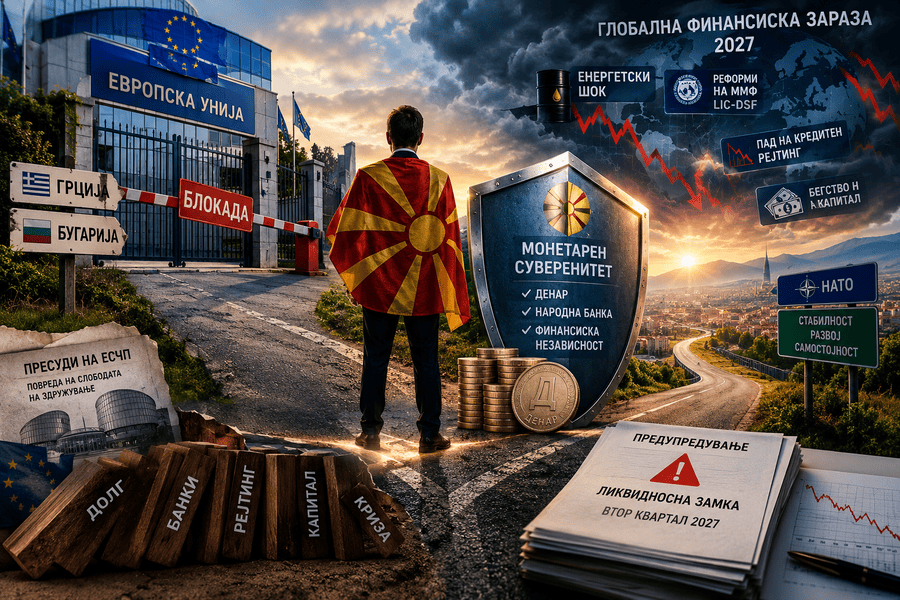
A Ticking Economic Time Bomb: Exposing the EU’s Secret Design to Destroy North Macedonia
On Saturday 29 August 2026 Iceland voters were asked a single question: “Should Iceland resume accession negotiations with the European Union?”
The people of Iceland answered: No!
This historic vote of the people of Republic of Iceland did not go unnoticed by the Macedonian people, with some Macedonians asking “Should Macedonia resume accession negotiations with the European Union?” “Why?”
Abstract
This article evaluates the prospective accession of North Macedonia to the European Union and the Eurozone through the dual lenses of normative political science and macroeconomic risk assessment. While the EU obscures EU systemic racial discrimination against Macedonian ethnic origin and identity, further critical secrets remain hidden regarding the EU’s true intentions for North Macedonia. Consequently, the current VMRO government is now on notice; Parliament must immediately initiate investigations and public hearings to preclude foreseeable EU harm and protect citizens from a catastrophe that remains in plain sight.
While the superficial discourse of EU lobbyists and underhanded integrationists frames accession into the EU as an absolute imperative for Macedonia, this article exposes a deeper, more sinister reality. The EU has carefully engineered a systemic “failure to consolidate debt”—an intentional economic booby-trap designed not as a flaw, but as a feature of the Union’s architecture. This is the EU’s ultimate Achilles’ heel: a deliberate design intended to precipitate failure. Much like the Union’s calculated concealment of racial discrimination against those of Macedonian ethnic origin, this financial deception is an act of intentional sabotage. Mathematically, the marginal costs of entering such a discriminatory and unstable system far outweigh the benefits. In plain English: North Macedonia is economically safer remaining outside the EU than embracing a ticking time bomb of unconsolidated debt risk.¹
By analyzing the structural fragility of the EU Economic and Monetary Union (EMU)—specifically the absence of fiscal consolidation that the EU desperately obscures through censorship and the avoidance of referendums—and juxtaposing it with the conditionality frameworks and legal precedents of the European Court of Human Rights, the conclusion is undeniable: the average Macedonian citizen is far better served staying out of this EU time bomb. Retaining monetary flexibility and NATO security integration, rather than assuming the asymmetric and secret risks of Eurozone membership, is a matter of national survival for Macedonia. To enter the Eurozone is to invite a “silent war” upon the Macedonian population—a rinse-and-repeat of the devastation visited upon Greece. The Greek financial crisis serves as a tangible, indisputable warning; to this day, millions of Greeks endure diminished pensions and eroded living standards as a direct result of this engineered fragility.²
It is time to expose the truth regarding the EU’s financial witchcraft and the sleight-of-hand sorcery used to mask its secret debt destruction.
- Introduction: The Normative and Legal Costs of Accession
The discourse surrounding North Macedonia’s EU accession is frequently clouded by political rhetoric and a persistent pattern of discrimination against Macedonian ethnic identity, origin, language, culture, and history, as documented by independent observers,³ but always ignoring how the EU member states of Greece and Bulgaria in coordination with Germany and Brussels violate the “ICERD,” which is a cornerstone of international human rights law; it commits its members to the elimination of racial discrimination and defines racial discrimination as any distinction based on race, colour, descent, or national or ethnic origin.
The law remains active and is monitored by the Committee on the Elimination of Racial Discrimination, which needs North Macedonian government officials to share data and reports of ethnic discrimination against Macedonian racial and ethnic identity occurring on the European continent against Macedonians, so the Committee can review human rights reports from member states to ensure they are complying with the treaty’s obligations, which the EU and EU member states do not do when it comes to citizens of Macedonian ethnic and racial origin and identity.⁴
Closing our eyes to the EU Racial Discrimination against Macedonians, for the sake of entertainment let us say an objective assessment must additionally address the hidden and secretive legal and normative friction inherent in the racial discrimination conflict of interests in the EU accession process when it comes to Republic of Macedonia, now more commonly known as N. Macedonia.⁵
Despite numerous rulings by the Strasbourg Court affirming the protection of Macedonian ethnic identity, continuous discrepancies and outright discrimination against Macedonians in the EU remain regarding the recognition of their ethnic identity, language, and historical heritage.⁶ A landmark case in this regard is Sidiropoulos and Others v. Greece (1998), where the European Court of Human Rights ruled that Greece’s refusal to register an association promoting Macedonian culture violated the applicants’ rights under the European Convention on Human Rights. This ruling established that the assertion of Macedonian ethnic identity constitutes a protected expression of freedom of assembly and association, and that states cannot deny such recognition based solely on bilateral political sensitivities.⁷
The historical roots of this discrimination are not a recent phenomenon. As early as 1907, the British journalist and author William Le Queux documented the systematic violence and diplomatic complicity directed against the Macedonian population in the Ottoman Balkans, noting that “the poor defenceless Macedonians are being daily outraged, murdered, or burned alive—the true facts being always suppressed and the news scarcely ever being allowed to leak out.”⁸ Le Queux further implicated European powers—specifically Germany—in abetting Greek armed bands engaged in what he termed “outrage, murder, and extermination” against Macedonians. While this source reflects the geopolitical language of its era, it constitutes primary historical evidence of a long-standing pattern of external interference and ethnic violence against the Macedonian population, a pattern that contextualises the contemporary obstruction of North Macedonia’s EU accession by member states invoking bilateral disputes.⁹
Furthermore, the exercise of absolute veto powers by member states—often rooted in bilateral disputes where the core purpose is not metric-based objective criteria but the elimination of Macedonian ethnic origin, identity, culture, language, and history—highlights a fundamental asymmetry in the EU’s conditionality framework.¹⁰
For the purpose of this analysis, however, we adopt a purely pragmatic, economically driven perspective to show the economic reasons why N. Macedonia is better off out of the EU, exposing what the EU hides from its own citizens by censorship and police power.¹¹
Even if one sets aside the well-documented normative and legal grievances regarding discrimination against Macedonian ethnic origin and identity, a rigorous economic and banking risk assessment dictates that North Macedonia’s accession to the Eurozone, under the current architecture of the EU, presents unacceptable macroeconomic vulnerabilities. Consequently, just another reason why Macedonian citizens’ ambitions of joining the EU are diminishing rapidly.
- The hidden EU ticking time bomb (a secret of the Macroeconomic Risks) because the EU in reality is an Incomplete Monetary Union, something the EU political elite try desperately to hide from Macedonians and their own EU citizens.
A core structural vulnerability of the Eurozone is the absence of a consolidated fiscal union and a failure to consolidate the debts. Unlike the United States of America, a single currency EU without a shared fiscal backstop leaves its EU member states catastrophically exposed as separate credit entities within a shared monetary system. This engineered and designed structural flaw of the EU secretly creates a “doom loop” between sovereign and bank debt,¹² making the EU monetary union incredibly highly susceptible to asymmetric shocks and warp speed contagion.¹³ Just to put this dirty EU secret in perspective, this is not a theoretical concern but a demonstrated fact that has already occurred and will very likely worsen considerably over time.
The empirical evidence (evidence that every Macedonian will be easily acquainted with) for this is well documented. The good old neighboring Greek sovereign debt crisis served as a critical event study, revealing that an EU currency union without fiscal backing can rapidly transform a localized sovereign liquidity problem into a bloc-wide systemic stress event;¹⁴ this is a no brainer, yet the EU goes to extremes to hide this: the question is why?
Econometric analyses of abnormal changes in sovereign spreads, Credit Default Swap (CDS) prices, and capital flows during crisis periods demonstrated that highly indebted or lower-growth EU members are disproportionately penalized by the market; making N. Macedonia the perfect target of this EU secret plan. Given the combination of political discrimination and economic risk, North Macedonia has little incentive to join such a fragile monetary arrangement that tries to sell itself as the best thing since the invention of the railroad, when in reality the EU is an engineered economic quicksand trap visible at the margins and hidden from the public. This is why the United States of America was and remains a much better engineered option than the EU.
For North Macedonia, the risk assessment at the margins bifurcates as follows:
· Outside the Euro (Retaining Monetary Sovereignty): The current N. Macedonia state maintains exchange-rate flexibility, independent interest rate mechanisms, and a lender-of-last-resort function for domestic banks. The primary costs are higher baseline borrowing costs and exposure to external financing risks.
· Inside the Euro (Without Fiscal Union): The state benefits from eliminated foreign exchange transaction costs and lower baseline inflation. However (and here is what the EU will not tell Macedonian citizens), unlike the United States, the EU by a known, but hidden, defective design sacrifices critical shock-absorption economic mechanisms, becoming highly exposed to imported sovereign contagion and lacking the tools to mitigate asymmetric economic shocks—as demonstrated by the Greek crisis, which will likely rinse and repeat, worse and worse, because no design flaw repairs are ever made by the broken EU (neither racial discrimination design flaws nor the failure to consolidate debts flaw); it is, bizarre, almost as if the EU is a ticking time bomb intentionally designed to implode due to an economically nuclear level contagion event, that very likely is coming.
Feel free to laugh, speculating that none of the EU defective design product peddling visitors to Macedonia ever say this part of the EU flaw out loud to the Macedonian people nor to their Macedonian leaders. Another EU hidden economic sorcery trick exposed to the public, very much like a product liability legal case for a known defective product and an intentional failure to warn the public.
- Marginal Analysis and the Calculus of Accession
In economic decision-making, the optimal choice is determined “at the margin.” Applying marginal analysis to North Macedonia’s potential Eurozone accession requires evaluating the first derivative of the economic utility function: how much does the national economic outcome of North Macedonia change with the marginal step of adopting the euro?
Currently, the marginal benefits of Macedonia joining the Euro (e.g., minor reductions in transaction costs and elimination of exchange rate risk) are vastly outweighed by the marginal costs that Macedonia would suffer if it joins the Euro (loss of independent monetary policy, exposure to Eurozone sovereign contagion, and inability to devalue to restore competitiveness during a shock; why on Earth would Macedonia want to give up these powers that give today’s Macedonia far more econometric tools than Greece or any other EU member state for that matter—one can bet that the EU scammers will never tell this part to the Macedonian citizens).
So, because the EU continues to employ racial discriminatory veto mechanisms against Macedonian ethnic identity and has failed to consolidate its ticking time bomb debt—despite historical warnings to figures like Helmut Kohl (who did not let his EU citizens vote on this, but instead intentionally pushed this EU monetary design defect from a dark hidden EU room out of sight of the uninformed EU consumer); specifically, regarding the necessity of political and fiscal union prior to monetary union—the marginal risk posed to N. Macedonia in joining an incomplete and discriminatory EU, with an intentionally designed defective EU ticking time bomb architecture, remains extremely prohibitively high; EU engineered secret monetary sorcery.
Furthermore, game theory elucidates the institutional instability of the current EMU. The system suffers from a collective-action problem: individual EU member states have a strong incentive to free-ride on the credibility of the common currency while resisting full fiscal mutualization.¹⁵ The resulting Nash equilibrium is characterized by an under-provision of solidarity and an overreliance on ad hoc, inefficient crisis management. Under a Pareto (80/20) framework of risk distribution, the vast majority of systemic fragility is driven by a few core variables: the absence of debt mutualization, banking-sovereign feedback loops, core-periphery growth divergence, and fluctuating institutional credibility.
- Market Pricing and the Feedback Loop of Risk
Because the Eurozone lacks fiscal consolidation, capital markets do not price “the EU” as a monolithic entity; rather, they price individual sovereigns (e.g., Italy, Spain, Germany) based on their distinct risk profiles. At the margin, this creates a self-fulfilling feedback loop for peripheral or smaller economies:
- Weaker institutional credibility or lower growth prospects lead to higher sovereign risk premiums.
- Higher borrowing costs crowd out domestic investment and suppress GDP growth.
- Slower growth deteriorates debt sustainability metrics, further increasing the risk premium.
- This would just wipe out N. Macedonia under the right conditions which the EU are likely secretly planning!
So, N. Macedonia VMRO leadership must never lose sight of the fact that when this EU policy credibility is uneven and structural adjustments are expected to take years, it is obvious as day that investors demand a higher risk premium immediately. This manifests through higher borrowing costs, lower asset valuations, and capital reallocation toward core economies. While this risk premium varies by country, smaller, open economies like North Macedonia would be highly vulnerable to these sudden shifts in market sentiment, lacking the fiscal space to absorb the shock. What the EU has planned for N. Macedonia will make the Greece debt crisis look like a picnic.
It is vital that VMRO immediately begin Parliamentary hearings on this inherent land mine that the EU has planned for N. Macedonia just in case N. Macedonia accidentally makes its unfettered accession into the Racial Discrimination EU. The VMRO government must do the responsible thing and request not only EU Parliamentary guarantees precluding UN defined Racial Discrimination against Macedonian Racial Ethnic Origin and Identity, but also very serious monetary and insurance guarantees against this hidden economic booby trap that is in place to destroy N.
Macedonia with economic nuclear destruction.
- Conclusion
While Ricardian comparative advantage theory supports the benefits of trade specialization within a monetary union,¹⁶ it cannot resolve the secret booby trapped financial and fiscal fragilities of an incomplete EU monetary union. Comparative advantage justifies the existence of a currency area, but it cannot prevent sovereign-debt contagion.
When synthesizing the explicit political veto mechanisms precluding North Macedonia’s seamless integration, the legal precedents regarding the discrimination of Macedonian ethnic identity,¹⁷ and the macroeconomic realities of an unconsolidated Eurozone, the conclusion is clear. On the margin, North Macedonia retains a stronger position by remaining outside the EU’s monetary and political framework. Retaining monetary flexibility provides crucial macroeconomic shock absorption, while maintaining a staunch, independent posture within NATO ensures hard security. Until the EU achieves true fiscal consolidation and resolves its normative dissonance regarding the specific discrimination against Macedonian ethnic origin and identity—a prospect that appears unlikely given entrenched discriminatory practices—the risks of North Macedonia’s EU accession fundamentally outweigh the benefits.
In contrast to the lack of direct accountability in EU institutions, Macedonian citizens enjoy a high degree of accessibility to their elected officials. On any given day, whether in Kriva Palanka, Prilep, Kočani, Kumanovo, Bitola, Tetovo, Ohrid, Radoviš, Kratovo, or any other town, village or province in North Macedonia, citizens may encounter their Prime Minister, Members of Parliament, or other policymakers and engage in direct dialogue without censorship or fear of reprisal, which is simply not the case with the elite EU dictatorship. This unique Macedonian grassroots democratic engagement underscores the value of Macedonian national sovereignty and the ability of Macedonian citizens to influence their own governance—an advantage that should not be lightly surrendered.
Footnotes
- Stiglitz, J. E. (2016). The Euro: How a common currency threatens the future of Europe. W. W. Norton & Company. See also: De Grauwe, P., & Ji, Y. (2013). Self-fulfilling crises in the Eurozone: An empirical test. Journal of International Money and Finance, 34, 15–36. https://doi.org/10.1016/j.jimonfin.2012.11.002
- Kampouris, N. (2025, June 10). The untold truth about the Greek economy behind the headlines. Greek Reporter. https://greekreporter.com/2025/06/10/greek-economy-truth/ Citing: Dr. Kosmas Marinakis, Senior Lecturer of Economics at Singapore Management University, and his research partner Achilleas Mantes, Macroeconomic Modeller at Agence Française de Développement.
- Danforth, L. M. (2003). The Macedonian conflict: Ethnic nationalism in a transnational world. Princeton University Press.
- United Nations General Assembly. (1965, December 21). International Convention on the Elimination of All Forms of Racial Discrimination. UN Treaty Series, vol. 660, p. 195.
- Tziampiris, A. (2012). The Macedonian name dispute and European Union accession. Southeast European and Black Sea Studies, 12(1), 153–171.
- Council of Europe. (1950). European Convention on Human Rights. https://www.echr.coe.int/documents/convention_eng.pdf
- European Court of Human Rights. (1998). Sidiropoulos and Others v. Greece (Application no. 26695/95). Judgment of 10 July 1998. https://hudoc.echr.coe.int/eng?i=001-58205
- Le Queux, W. (1907). The Near East: The Present Situation in Montenegro, Bosnia, Servia, Bulgaria, Roumania, Turkey and Macedonia. Doubleday, Page & Company, pp. 6–7. For a contemporary discussion and full citation of this passage in both English and Macedonian, see Gligorov, S. (2026, August 16). A Prefatory Note. PelaNet. https://pelanet.mk/?p=81691
- Danforth, L. M. (2003); Tziampiris, A. (2012).
- Tziampiris, A. (2012); Danforth, L. M. (2003).
- Council of the European Union. (2025, December 15). Implementing Regulation (EU) 2025/2568. Official Journal of the European Union. This regulation added Jacques Baud to the EU sanctions list; cited cited here as an example of EU censorship and police power.
- Acharya, V. V., Drechsler, I., & Schnabl, P. (2014). A Pyrrhic victory? Bank bailouts and sovereign credit risk. The Journal of Finance, 69(6), 2689–2739. https://doi.org/10.1111/jofi.12206
- Stiglitz, J. E. (2016).
- De Grauwe, P., & Ji, Y. (2013).
- Stiglitz, J. E. (2016).
- Mundell, R. A. (1961). A theory of optimum currency areas. The American Economic Review, 51(4), 657–665. https://www.jstor.org/stable/1812792
- Sidiropoulos and Others v. Greece (1998); Tziampiris, A. (2012).
Bosevski:
A Ticking Economic Time Bomb: Exposing the EU’s Secret Design to Destroy North Macedonia
On Saturday 29 August 2026 Iceland voters were asked a single question: “Should Iceland resume accession negotiations with the European Union?”
The people of Iceland answered: No!
This historic vote of the people of Republic of Iceland did not go unnoticed by the Macedonian people, with some Macedonians asking “Should Macedonia resume accession negotiations with the European Union?” “Why?”
Abstract
This article evaluates the prospective accession of North Macedonia to the European Union and the Eurozone through the dual lenses of normative political science and macroeconomic risk assessment. While the EU obscures EU systemic racial discrimination against Macedonian ethnic origin and identity, further critical secrets remain hidden regarding the EU’s true intentions for North Macedonia. Consequently, the current VMRO government is now on notice; Parliament must immediately initiate investigations and public hearings to preclude foreseeable EU harm and protect citizens from a catastrophe that remains in plain sight.
While the superficial discourse of EU lobbyists and underhanded integrationists frames accession into the EU as an absolute imperative for Macedonia, this article exposes a deeper, more sinister reality. The EU has carefully engineered a systemic “failure to consolidate debt”—an intentional economic booby-trap designed not as a flaw, but as a feature of the Union’s architecture. This is the EU’s ultimate Achilles’ heel: a deliberate design intended to precipitate failure. Much like the Union’s calculated concealment of racial discrimination against those of Macedonian ethnic origin, this financial deception is an act of intentional sabotage. Mathematically, the marginal costs of entering such a discriminatory and unstable system far outweigh the benefits. In plain English: North Macedonia is economically safer remaining outside the EU than embracing a ticking time bomb of unconsolidated debt risk.¹
By analyzing the structural fragility of the EU Economic and Monetary Union (EMU)—specifically the absence of fiscal consolidation that the EU desperately obscures through censorship and the avoidance of referendums—and juxtaposing it with the conditionality frameworks and legal precedents of the European Court of Human Rights, the conclusion is undeniable: the average Macedonian citizen is far better served staying out of this EU time bomb. Retaining monetary flexibility and NATO security integration, rather than assuming the asymmetric and secret risks of Eurozone membership, is a matter of national survival for Macedonia. To enter the Eurozone is to invite a “silent war” upon the Macedonian population—a rinse-and-repeat of the devastation visited upon Greece. The Greek financial crisis serves as a tangible, indisputable warning; to this day, millions of Greeks endure diminished pensions and eroded living standards as a direct result of this engineered fragility.²
It is time to expose the truth regarding the EU’s financial witchcraft and the sleight-of-hand sorcery used to mask its secret debt destruction.
- Introduction: The Normative and Legal Costs of Accession
The discourse surrounding North Macedonia’s EU accession is frequently clouded by political rhetoric and a persistent pattern of discrimination against Macedonian ethnic identity, origin, language, culture, and history, as documented by independent observers,³ but always ignoring how the EU member states of Greece and Bulgaria in coordination with Germany and Brussels violate the “ICERD,” which is a cornerstone of international human rights law; it commits its members to the elimination of racial discrimination and defines racial discrimination as any distinction based on race, colour, descent, or national or ethnic origin.
The law remains active and is monitored by the Committee on the Elimination of Racial Discrimination, which needs North Macedonian government officials to share data and reports of ethnic discrimination against Macedonian racial and ethnic identity occurring on the European continent against Macedonians, so the Committee can review human rights reports from member states to ensure they are complying with the treaty’s obligations, which the EU and EU member states do not do when it comes to citizens of Macedonian ethnic and racial origin and identity.⁴
Closing our eyes to the EU Racial Discrimination against Macedonians, for the sake of entertainment let us say an objective assessment must additionally address the hidden and secretive legal and normative friction inherent in the racial discrimination conflict of interests in the EU accession process when it comes to Republic of Macedonia, now more commonly known as N. Macedonia.⁵
Despite numerous rulings by the Strasbourg Court affirming the protection of Macedonian ethnic identity, continuous discrepancies and outright discrimination against Macedonians in the EU remain regarding the recognition of their ethnic identity, language, and historical heritage.⁶ A landmark case in this regard is Sidiropoulos and Others v. Greece (1998), where the European Court of Human Rights ruled that Greece’s refusal to register an association promoting Macedonian culture violated the applicants’ rights under the European Convention on Human Rights. This ruling established that the assertion of Macedonian ethnic identity constitutes a protected expression of freedom of assembly and association, and that states cannot deny such recognition based solely on bilateral political sensitivities.⁷
The historical roots of this discrimination are not a recent phenomenon. As early as 1907, the British journalist and author William Le Queux documented the systematic violence and diplomatic complicity directed against the Macedonian population in the Ottoman Balkans, noting that “the poor defenceless Macedonians are being daily outraged, murdered, or burned alive—the true facts being always suppressed and the news scarcely ever being allowed to leak out.”⁸ Le Queux further implicated European powers—specifically Germany—in abetting Greek armed bands engaged in what he termed “outrage, murder, and extermination” against Macedonians. While this source reflects the geopolitical language of its era, it constitutes primary historical evidence of a long-standing pattern of external interference and ethnic violence against the Macedonian population, a pattern that contextualises the contemporary obstruction of North Macedonia’s EU accession by member states invoking bilateral disputes.⁹
Furthermore, the exercise of absolute veto powers by member states—often rooted in bilateral disputes where the core purpose is not metric-based objective criteria but the elimination of Macedonian ethnic origin, identity, culture, language, and history—highlights a fundamental asymmetry in the EU’s conditionality framework.¹⁰
For the purpose of this analysis, however, we adopt a purely pragmatic, economically driven perspective to show the economic reasons why N. Macedonia is better off out of the EU, exposing what the EU hides from its own citizens by censorship and police power.¹¹
Even if one sets aside the well-documented normative and legal grievances regarding discrimination against Macedonian ethnic origin and identity, a rigorous economic and banking risk assessment dictates that North Macedonia’s accession to the Eurozone, under the current architecture of the EU, presents unacceptable macroeconomic vulnerabilities. Consequently, just another reason why Macedonian citizens’ ambitions of joining the EU are diminishing rapidly.
- The hidden EU ticking time bomb (a secret of the Macroeconomic Risks) because the EU in reality is an Incomplete Monetary Union, something the EU political elite try desperately to hide from Macedonians and their own EU citizens.
A core structural vulnerability of the Eurozone is the absence of a consolidated fiscal union and a failure to consolidate the debts. Unlike the United States of America, a single currency EU without a shared fiscal backstop leaves its EU member states catastrophically exposed as separate credit entities within a shared monetary system. This engineered and designed structural flaw of the EU secretly creates a “doom loop” between sovereign and bank debt,¹² making the EU monetary union incredibly highly susceptible to asymmetric shocks and warp speed contagion.¹³ Just to put this dirty EU secret in perspective, this is not a theoretical concern but a demonstrated fact that has already occurred and will very likely worsen considerably over time.
The empirical evidence (evidence that every Macedonian will be easily acquainted with) for this is well documented. The good old neighboring Greek sovereign debt crisis served as a critical event study, revealing that an EU currency union without fiscal backing can rapidly transform a localized sovereign liquidity problem into a bloc-wide systemic stress event;¹⁴ this is a no brainer, yet the EU goes to extremes to hide this: the question is why?
Econometric analyses of abnormal changes in sovereign spreads, Credit Default Swap (CDS) prices, and capital flows during crisis periods demonstrated that highly indebted or lower-growth EU members are disproportionately penalized by the market; making N. Macedonia the perfect target of this EU secret plan. Given the combination of political discrimination and economic risk, North Macedonia has little incentive to join such a fragile monetary arrangement that tries to sell itself as the best thing since the invention of the railroad, when in reality the EU is an engineered economic quicksand trap visible at the margins and hidden from the public. This is why the United States of America was and remains a much better engineered option than the EU.
For North Macedonia, the risk assessment at the margins bifurcates as follows:
· Outside the Euro (Retaining Monetary Sovereignty): The current N. Macedonia state maintains exchange-rate flexibility, independent interest rate mechanisms, and a lender-of-last-resort function for domestic banks. The primary costs are higher baseline borrowing costs and exposure to external financing risks.
· Inside the Euro (Without Fiscal Union): The state benefits from eliminated foreign exchange transaction costs and lower baseline inflation. However (and here is what the EU will not tell Macedonian citizens), unlike the United States, the EU by a known, but hidden, defective design sacrifices critical shock-absorption economic mechanisms, becoming highly exposed to imported sovereign contagion and lacking the tools to mitigate asymmetric economic shocks—as demonstrated by the Greek crisis, which will likely rinse and repeat, worse and worse, because no design flaw repairs are ever made by the broken EU (neither racial discrimination design flaws nor the failure to consolidate debts flaw); it is, bizarre, almost as if the EU is a ticking time bomb intentionally designed to implode due to an economically nuclear level contagion event, that very likely is coming.
Feel free to laugh, speculating that none of the EU defective design product peddling visitors to Macedonia ever say this part of the EU flaw out loud to the Macedonian people nor to their Macedonian leaders. Another EU hidden economic sorcery trick exposed to the public, very much like a product liability legal case for a known defective product and an intentional failure to warn the public.
- Marginal Analysis and the Calculus of Accession
In economic decision-making, the optimal choice is determined “at the margin.” Applying marginal analysis to North Macedonia’s potential Eurozone accession requires evaluating the first derivative of the economic utility function: how much does the national economic outcome of North Macedonia change with the marginal step of adopting the euro?
Currently, the marginal benefits of Macedonia joining the Euro (e.g., minor reductions in transaction costs and elimination of exchange rate risk) are vastly outweighed by the marginal costs that Macedonia would suffer if it joins the Euro (loss of independent monetary policy, exposure to Eurozone sovereign contagion, and inability to devalue to restore competitiveness during a shock; why on Earth would Macedonia want to give up these powers that give today’s Macedonia far more econometric tools than Greece or any other EU member state for that matter—one can bet that the EU scammers will never tell this part to the Macedonian citizens).
So, because the EU continues to employ racial discriminatory veto mechanisms against Macedonian ethnic identity and has failed to consolidate its ticking time bomb debt—despite historical warnings to figures like Helmut Kohl (who did not let his EU citizens vote on this, but instead intentionally pushed this EU monetary design defect from a dark hidden EU room out of sight of the uninformed EU consumer); specifically, regarding the necessity of political and fiscal union prior to monetary union—the marginal risk posed to N. Macedonia in joining an incomplete and discriminatory EU, with an intentionally designed defective EU ticking time bomb architecture, remains extremely prohibitively high; EU engineered secret monetary sorcery.
Furthermore, game theory elucidates the institutional instability of the current EMU. The system suffers from a collective-action problem: individual EU member states have a strong incentive to free-ride on the credibility of the common currency while resisting full fiscal mutualization.¹⁵ The resulting Nash equilibrium is characterized by an under-provision of solidarity and an overreliance on ad hoc, inefficient crisis management. Under a Pareto (80/20) framework of risk distribution, the vast majority of systemic fragility is driven by a few core variables: the absence of debt mutualization, banking-sovereign feedback loops, core-periphery growth divergence, and fluctuating institutional credibility.
- Market Pricing and the Feedback Loop of Risk
Because the Eurozone lacks fiscal consolidation, capital markets do not price “the EU” as a monolithic entity; rather, they price individual sovereigns (e.g., Italy, Spain, Germany) based on their distinct risk profiles. At the margin, this creates a self-fulfilling feedback loop for peripheral or smaller economies:
- Weaker institutional credibility or lower growth prospects lead to higher sovereign risk premiums.
- Higher borrowing costs crowd out domestic investment and suppress GDP growth.
- Slower growth deteriorates debt sustainability metrics, further increasing the risk premium.
- This would just wipe out N. Macedonia under the right conditions which the EU are likely secretly planning!
So, N. Macedonia VMRO leadership must never lose sight of the fact that when this EU policy credibility is uneven and structural adjustments are expected to take years, it is obvious as day that investors demand a higher risk premium immediately. This manifests through higher borrowing costs, lower asset valuations, and capital reallocation toward core economies. While this risk premium varies by country, smaller, open economies like North Macedonia would be highly vulnerable to these sudden shifts in market sentiment, lacking the fiscal space to absorb the shock. What the EU has planned for N. Macedonia will make the Greece debt crisis look like a picnic.
It is vital that VMRO immediately begin Parliamentary hearings on this inherent land mine that the EU has planned for N. Macedonia just in case N. Macedonia accidentally makes its unfettered accession into the Racial Discrimination EU. The VMRO government must do the responsible thing and request not only EU Parliamentary guarantees precluding UN defined Racial Discrimination against Macedonian Racial Ethnic Origin and Identity, but also very serious monetary and insurance guarantees against this hidden economic booby trap that is in place to destroy N.
Macedonia with economic nuclear destruction.
- Conclusion
While Ricardian comparative advantage theory supports the benefits of trade specialization within a monetary union,¹⁶ it cannot resolve the secret booby trapped financial and fiscal fragilities of an incomplete EU monetary union. Comparative advantage justifies the existence of a currency area, but it cannot prevent sovereign-debt contagion.
When synthesizing the explicit political veto mechanisms precluding North Macedonia’s seamless integration, the legal precedents regarding the discrimination of Macedonian ethnic identity,¹⁷ and the macroeconomic realities of an unconsolidated Eurozone, the conclusion is clear. On the margin, North Macedonia retains a stronger position by remaining outside the EU’s monetary and political framework. Retaining monetary flexibility provides crucial macroeconomic shock absorption, while maintaining a staunch, independent posture within NATO ensures hard security. Until the EU achieves true fiscal consolidation and resolves its normative dissonance regarding the specific discrimination against Macedonian ethnic origin and identity—a prospect that appears unlikely given entrenched discriminatory practices—the risks of North Macedonia’s EU accession fundamentally outweigh the benefits.
In contrast to the lack of direct accountability in EU institutions, Macedonian citizens enjoy a high degree of accessibility to their elected officials. On any given day, whether in Kriva Palanka, Prilep, Kočani, Kumanovo, Bitola, Tetovo, Ohrid, Radoviš, Kratovo, or any other town, village or province in North Macedonia, citizens may encounter their Prime Minister, Members of Parliament, or other policymakers and engage in direct dialogue without censorship or fear of reprisal, which is simply not the case with the elite EU dictatorship. This unique Macedonian grassroots democratic engagement underscores the value of Macedonian national sovereignty and the ability of Macedonian citizens to influence their own governance—an advantage that should not be lightly surrendered.
Footnotes
- Stiglitz, J. E. (2016). The Euro: How a common currency threatens the future of Europe. W. W. Norton & Company. See also: De Grauwe, P., & Ji, Y. (2013). Self-fulfilling crises in the Eurozone: An empirical test. Journal of International Money and Finance, 34, 15–36. https://doi.org/10.1016/j.jimonfin.2012.11.002
- Kampouris, N. (2025, June 10). The untold truth about the Greek economy behind the headlines. Greek Reporter. https://greekreporter.com/2025/06/10/greek-economy-truth/ Citing: Dr. Kosmas Marinakis, Senior Lecturer of Economics at Singapore Management University, and his research partner Achilleas Mantes, Macroeconomic Modeller at Agence Française de Développement.
- Danforth, L. M. (2003). The Macedonian conflict: Ethnic nationalism in a transnational world. Princeton University Press.
- United Nations General Assembly. (1965, December 21). International Convention on the Elimination of All Forms of Racial Discrimination. UN Treaty Series, vol. 660, p. 195.
- Tziampiris, A. (2012). The Macedonian name dispute and European Union accession. Southeast European and Black Sea Studies, 12(1), 153–171.
- Council of Europe. (1950). European Convention on Human Rights. https://www.echr.coe.int/documents/convention_eng.pdf
- European Court of Human Rights. (1998). Sidiropoulos and Others v. Greece (Application no. 26695/95). Judgment of 10 July 1998. https://hudoc.echr.coe.int/eng?i=001-58205
- Le Queux, W. (1907). The Near East: The Present Situation in Montenegro, Bosnia, Servia, Bulgaria, Roumania, Turkey and Macedonia. Doubleday, Page & Company, pp. 6–7. For a contemporary discussion and full citation of this passage in both English and Macedonian, see Gligorov, S. (2026, August 16). A Prefatory Note. PelaNet. https://pelanet.mk/?p=81691
- Danforth, L. M. (2003); Tziampiris, A. (2012).
- Tziampiris, A. (2012); Danforth, L. M. (2003).
- Council of the European Union. (2025, December 15). Implementing Regulation (EU) 2025/2568. Official Journal of the European Union. This regulation added Jacques Baud to the EU sanctions list; cited cited here as an example of EU censorship and police power.
- Acharya, V. V., Drechsler, I., & Schnabl, P. (2014). A Pyrrhic victory? Bank bailouts and sovereign credit risk. The Journal of Finance, 69(6), 2689–2739. https://doi.org/10.1111/jofi.12206
- Stiglitz, J. E. (2016).
- De Grauwe, P., & Ji, Y. (2013).
- Stiglitz, J. E. (2016).
- Mundell, R. A. (1961). A theory of optimum currency areas. The American Economic Review, 51(4), 657–665. https://www.jstor.org/stable/1812792
- Sidiropoulos and Others v. Greece (1998); Tziampiris, A. (2012).
Written from Washington, D.C., USA , STEVE GLIGOROV, J.D. Esq. B.S., Cert. Int. Trade Law & Int. Comm. Arbt.
Рубриката „СТАВ“ се лични ставови на авторите и Pelanet.mk не носат одговорност за нив.